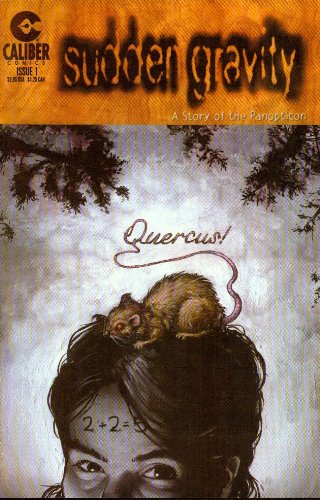
Interview with Greg Ruth over his works since Caliber till now and how he sees movies, comics, animation, the future of comics and his works.
I remember
on the 90's when I was younger searching for several titles and comics from
Caliber Press.
I do
remember being fixed on some that I've thought that were pretty good:
"Harlequin" by Steve Csutoras and Eisner Award nominee, Stefano Gaudiano
"Exit" by
Nabiel Kanan
"Through the
wood and beneath the Moon" by Tom
Pappalardo & Matt Smith
"Walk through
October" by Jeffrey Brown and Matt Smith
"Kingdom
of the Wicked" by Ian Edginton and Disraeli (who later worked on Neil Gaiman "The Sandman")
And
of course on Saint Germaine, Deadworld among others like on the interview that
I've made to Gary Reed on the previous post, but
your title "Sudden Gravity" was a gem to me at the time .
 |
| Sudden Gravity 1 - by Greg Ruth |
 |
| Sudden Gravity 2 - by Greg Ruth |
 |
| Sudden Gravity 3 - by Greg Ruth |
 |
| Sudden Gravity 4/5 - by Greg Ruth | | |
1. When did
you find Gary and how was the atmosphere then by being published and released
by Caliber with all these great Authors? Did you swap ideas for stories with
the other Caliber Authors? Which comic book by Caliber did you loved most at
that time?
Greg Ruth: Boy
Let me think... I believe I came across them while trawling through books
specifically looking at and for a publisher. There weren't nearly as many
resources back in those days, far fewer small press outfits to break into as
there is today, so I found just checking out books I liked, noting that many of
them had consistently the same editors, and then tracked those poor bastards
down nagging them with samples. I was already being sort of tutored by Lou
Stathis at Vertigo, who was an immense encouragement, and I had done a couple
of the Factoid books for Paradox Press, but for Sudden Gravity I had sent out
samples and a rough pitch proposal, Gary was the one who had gotten it right
away. He was just completely into it and understood what I aimed to do. Caliber
was kind of the place to go if you were looking to do stories that weren't the
typical cape tales that DC and Marvel were doing- I think a result of that is
celebrated by their insanely long list of big career folk that all went through
there at one time or another. They were available and ready to roll in many
ways, and they loved their genre work especially. Iliked a bunch of what they
were putting out at the time, it's funny to think back on it as I now know many
of those guys professionally now. I think nearly everyone I liked is still
working in comics today- which really says something. It was a place for people
passionate about the medium.
2. How did
you conceived this story ?(it seems to me that you've inspiration on it by
seeing 'The Kingdom' by Lars Von Trier).
 |
| The Kingdom by Lars Von Trier |
Greg Ruth: The Kingdom
hadn't come out here in the US until around the second or third issue. They
showed it in movie theaters in NYC all at once, maybe taking five or six hours
to do it. No one was ever in those theaters except us, but I was mesmerized by
it- and horrified as well. It was like seeing a film version of what I was
doing in the comic, and it gutted me. As much as I loved The Kingdom, I
couldn't reconcile the book with it as it was and suddenly, in mid stream, had
to rejigger much of the narrative. They're entirely different stories, but
where I could I felt compelled to cut out similarities- especially the ghost
story aspects- Julius int he book was originally a ghost amongst other kids who
had been experimented on by Dr. Bonticou, so I had to change that completely. I
did read someplace that Von Trier got his inspiration to do The Kingdom from
Twin Peaks- specifically the hospital in the town, and I think that explains a
great deal as to the similarities. I remember Sudden Gravity getting started in
earnest while watching the second season premier and thinking "I want to
know more about that hospital"- hospitals always give me to willies-
especially at night, and the sterile humanity there was rich soil for telling
scary stories.
 |
Twin Peaks poster
Have you done updates on the graphic novel
that you released after the single issue stories on the drawings and on the
story?
Greg Ruth: When
Dark Horse and I decided to collected the series, my editor and dear friend
Shawna Gore agreed it was a good chance to take another swipe at the book
editorially. It had been truncated quite a bit down from its original twelve
issues and then had taken a second blow via Lars Von Trier and I think was
severely messy as a narrative because of that. Plus I had now done a whole
other never published book, other comics work and Freaks of the Heartland and
was starting up Conan with Kurt Busiek so I felt a bit more schooled in comics
and wanted a chance to retrofit Sudden Gravity from that new place of
experience.The one rule Shawna and I agreed to entirely starting out was not
to George Lucas this thing- there could be no new drawing for the book. I could
cut and paste it in different shapes, and did that readily- even imported some
unpublished work back into the story. Much of the dialogue was rewritten and
even some of the plot threads were completely revamped, cut out or enhanced. It
was like a class assignment in editing a narrative and I learned a ton from
that process. We ended up using the never published sixth issue cover for the
Dark Horse edition and after it was all said and done- I felt like I had
finally told that story as best as it could have been done so given the
circumstances.

3. I know
that you did also a book with Steve Niles called 'Freaks in the heartand', was
it a different experience for you while working with Steve on another
publishing company?It's a story of loneliness and the way people see different
individuals (like 'Freaks' by Todd Browning), do you see yourself a bit of a
'freak' on the Comics market?
|
 |
| Freaks on the Heartland GN with Steve Niles |
 |
| Freaks on the Heartland - 1 - with Steve Niles |
 |
| Freaks on the Heartland - 2 - with Steve Niles |
 |
| Freaks on the Heartland - 3 - with Steve Niles |
 |
| Freaks on the Heartland - 4 - with Steve Niles |
 |
| Freaks on the Heartland - 5 - with Steve Niles |
 |
| Freaks on the Heartland - 6 - with Steve Niles |
Greg Ruth: Totally
different. It's been like that with every publishing house I've worked at- each
place has a different culture, different folk, and each book for me at least,
has been a different genre. I kind of love that to be honest. The variance
keeps things interesting. Working with Steve was completely different than
working with Kurt or even for Spencer on the Matrix Comics in those days. They
each brought something entirely different to the table and I learned a million
tons of wisdom from each of them. I remember when I was in Lou's office at
Vertigo once- he'd ask me to do a few pages of something, maybe a Hellblazer
story he'd given me, or just pages from Sudden Gravity, and then I'd go back in and he'd review them and
help me make them better. it was like my own personal art school- but Lou once
said that I was a total freak int he industry and it would be hard for me as a
result. The work and perspective just didn't fit easily into what most folk
were doing but it was important to keep going because while it make take a
while once I convinced publishers and readers to take a serious look things
would flourish... but it would take a long time. And it turns out, as with most
everything Lou said, he was totally right.
 |
| Matrix comics with a short story by Greg Ruth |
 |
| A page from Matrix comics |
Greg Ruth: I think the
loneliness and isolation of the characters in SG, and even in my new book, The
Lost Boy, are more a reflection of growing up in Houston. I was kind of a
weirdo there- not really into sports at all, which then was almost the entire
culture of the place, so I spent a great many hours alone in my room chasing
down my imagination. I think that sense of self-isolation informs all my
stories and work - it's there in many of the covers and spot illos I have done
over the years. Even the music videos now that I think about it.
 |
| The new work by Greg Ruth |
4. Doing a
comic book is different compared to doing a movie over one art being static and
the other in movement, do you think that a certain image creates more impact on
a comic book rather than on a movie over this?
Greg Ruth: Oh
absolutely. There are panels I can recall from books I read twenty years ago
that come up in my mind as crisp as the day I read them. Scenes like V leaping
in silhouette from a rooftop from V for Vendetta, or Sebastian O lighting a
cigarette, The Doom Patrol falling into a DaDaist painting, Doctor Manhattan
yelling at the tv studio in Watchmen... I can even recall the exact page and
panel sequence from the Dave McKean's Cages where I decided I didn't just love
comics, but wanted to do them for a living. Thanks to Allen Spiegel and Dave, I
now have that original page up in my studio and I look at it everyday as a
reminder of that moment. With comics the reader is on control of time in a way
they aren't in movies, or even prose. You can affix yourself upon a single
image and pause and soak it in, in a completely different and unique way in
comics, and pick up the pace again when you're ready to go without a hitch.
Will Eisner always said that comics happens in the space between the panels-
and he's totally right (Will was right about just about everything too!).
Comics is something that happens in your head, and the page and the art and
words are really triggers for that moment. But with comics you lead the reader
more because you have the opportunity to shape that narrative with images. You
work in partnership with a reader as a comics writer/artist in a way that is
very special and specific to the medium. it's probably the medium's greatest
strength and also the hardest to accomplish well.
 |
| V for Vendetta by Alan Moore and David Lloyd |
 |
| Doom Patrol by Grant Morrison and Richard Case |
 |
| Sebastian O by Grant Morrison and Steve Yeowell |
 |
| A panel from Dave Mckean "Cages" |
5. With
almost all the work today being digital, how do see you this? Do you think that
texture's needed nowadays on Comics?
Greg Ruth: Well I
don't worry about that too much- the digital stuff is getting overdone a bit,
but that's what happens with any new toy in a medium. It gets overused via the
excitement of it and then settles back
into its own arena where it belongs. I
much prefer to see hand drawn material and that still overwhelms the
medium as a staple. The work being done on tablets is not my thing at all. I
got a wacom a few years ago and gave it a try to help me better do Conan, and I
just hated it. It's not my thing, and that's fine. I use the computer a great
deal to make my books, but I don't draw on it- I just need to feel the tactile
experience of ink and paper, and I think it makes for better work because it
allows for accidents to happen. You can't have accidents in a digital sphere-
not really, and so that kind of organic handle is important. We're not digital
creatures so I think we relate better to likewise work. Books are of a certain
size because of how they fit ergonomically in the hand. We live in a physical
world and we need to touch things, smell things and not just see them. So I
think there's nothing to fear or loathe in digital stuff- it leaves me a bit
cold sometimes, but it's just another tool for telling stories and I think that
just contributes to the overall ethos. It's ultimately additive and if it
brings in more people to the medium, then I think that's great. A great example
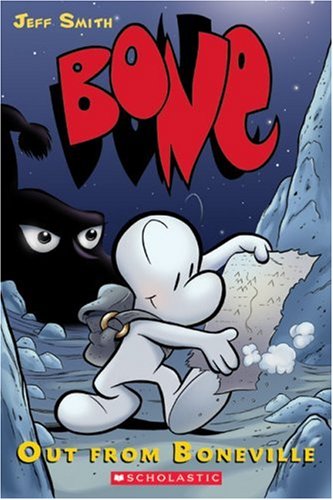
of the two sides working well is Jeff Smith's Bone books from Scholastic- his
hand drawn art and the absolutely stunning digital color just sing together in
perfect pitch. Whereas I find the exact opposite to be true of The work in The
Dark Knight Returns. Like any tool you just need to recognize where it's strengths
and weaknesses are and use it appropriately. Some people use it as a crutch or
get dazzled by what i can do so easily and forget that in the end, you still
need to know how to draw and paint in order to use that tool properly. The best
digital artists comes from organic, practical training.
 |
| Dark Knight strikes again by Frank Miller |
 |
| Bone by Jeff Smith |
|
|
|
6. Which
are your main tools while creating comic books? And does the stories that you
provide are stuck for a long time on your brain?
Greg Ruth: For me it's
sumi ink, paper the scanner and photoshop for assembling and editing the
drawings. I use water color and other paints and textures as layers in my color
comics, and in some of my black and white work too, but overall I like to
mostly just use the computer as a glorified paste up machine. Provides a level
of freedom and editorial power unmatched anywhere else. My rule for the
computer is if you can't do it in a darkroom, you probably shouldn't do it on a
computer.
As to the
second question- Oh my yes. I can recall in detail just about every panel of
every comics story I have ever drawn or written and drawn. It's why I can't
really ever read my own books- not even Sudden Gravity after all these many
years- it's just impossible to experience them as a reader would having made
them myself. They never go away, not ever.
 |
| Sudden Gravity page |
7. You draw
lots of Universal monsters by comission, what do you think of that period of
the movies with Boris Karloff, Lon Chaney, Bela Lugosi among others?
 |
| Dracula with Bela Lugosi |
 |
| The bride of Frankenstein with Boris Karloff |
 |
| The Wolfman with Lon Chaney |
Greg Ruth: Oh I love
them of course. LOVE them. When I was a kid in the wayback times growing up in
the 1970's and '80's, before the internet and even cable tv, Sunday afternoon
Mystery Theater, or the Creature Double Feature were like my church. Those and
the old Westerns too. But Godzilla, Frankenstein, Dracula and the Mummy...
these were the gods of my personal Olympus, so getting to do portraits of them
all for Comicon this year was a spectacularly fun exercise in honoring those
old movies.
 |
| Frankenstein by Greg Ruth |
 |
| Bride of Frankenstein by Greg Ruth |
 |
| Wolfman by Greg Ruth |
 |
| Nosferatu by Greg Ruth |
|
|
|
8. Do you
like the works by Hayao Miyazaki over being less digital than the common
animation nowadays or do you think that perhaps it's something that's stuck on
our mind over his movies that we saw when we were kids?
Greg Ruth: Of
course I adore Myazaki- absolutely. Maybe because he comes from comics too, or
just for his insane imagination... But Chuck Jones blows me away and especially
so some of the older Disney stuff. 101 Dalmations in particular, or the
Sorcerer's Apprentice for the scratchy pencil lines and free form movement of
the characters. I could watch those films with the sound off. Even Akira and
that combination of digital art with hand drawn cell animation is great stuff
too. But I also adore animation like Bob's Burgers or even the Star Wars: Clone
Wars show... maybe the latter for the kind of Thunderbirds are Go approach.
Maybe all of it due to some form of nostalgia... I really love the work at the
end credits for most Pixar films- that kind of mod-1960's style flat animation.
They did some great stuff in many of the side projects for Kung Fu Panda that
also work remarkably well. But the touchstone overall has got to be the old
Fleischer stuff- the SUperman cartoons, Popeye, Betty Boop... they are just so
fundamentally weird and wondrous
 |
| Akira Movie |
 |
| Chuck Jones - Grinch |
 |
| Miyazaki - Princess Mononoke |
 |
| Walt Disney - Sorcerer's aprentice |
 |
| Thunderbirds are go |
 |
| Fleischer - Superman |
 |
| Miyazaki - Nausicaa - Comic book |
9. Was the
process of making Lost Boy similar to Sudden Gravity?
I
think in some ways it was- It was my first return to a 9-panel grid approach
since Sudden Gravity, so there's that. But it's similarities more reside in how
the characters grew themselves and how the narrative expanded and the
world-building was done. Genre similarities aside, I felt like I was more a
conduit for the story than its master, and the characters after a short time
started dictating tome what they wanted to say and do rather than the other way
around. For me that was both the most fun and the most difficult part because
it means you get to fall into your story like Dorothy tumbling into Oz, but as a storyteller, you
can't do that entirely and you have to be the Wizard too in order to keep the
narrative mechanically functioning and the pace moving along. It can be all to
easily to be lured by the siren song of your own creation sometimes- especially
when you're world building, but it's important to remember where the sirens
lead you, and steer clear of listening to it too much. I think a big difference
can be found in that with The Lost Boy I had a strong editorial team
mercilessly whipping me along the road, whereas I was more or less on my own
with Sudden Gravity. I think The Lost Boy Is a far more successful story as a
result of having that oversight. Knowing David and Adam, my editors on that
book tethering em to shore let me swim out further and test boundaries in a way
I couldn't have otherwise. Fence can sometimes make us freer.
 |
| Lost boy art by Greg Ruth |
10. Who are
the comic book artists that you admire most?
Well
Jim Woodring first. To be able to do what he does with little or no dialogue is
amazing. Tony Millionaire's Sock Monkey comics are some of the best ever... so
is Ernie Bushmiller's Nancy and Sluggo comics. It was Kent Williams, Dave
McKean and Jon Muth who got me wanting to do comics into he first place- J's
sumi drawings continue to be a perpetual influence. But Jack Davis, Harvey
Kurtzman, Frank Quitely, John Ridgeway, Mattotti, Goseki Kojima... I could go
on for ever with a proper list. There's so much great work out there and so
much more being done now
 |
| Tony Millionaire |
 |
| Jon J. Muth |
 |
| Flex Mentallo by Grant Morrison and Frank Quitely |
 |
| Jim Woodring |
 |
| Kent Williams |
 |
| Mattotti - Murmur |
 |
| Goseki Kojima - Lone Wolf and cub |
11. Do you
see comics as a vehicle that could help other Arts or are they merely 'comics'?
Well I
think both is more likely true. Comics are their own thing to be sure, and its
a medium that still has a lot of self exploration to do and still has major
benchmarks to reach- I think that's much of what excites me about the medium:
the sheer potential it still has to tells tories. I think they can inform
tremendously other mediums and vice versa. Carl Dryer's The Passion of Joan of
Arc is one of the most important comics narratives on film for example, and I
think something like Watchmen as faithful as it was to the book and successful
in capturing much of the graphic novel shows the failures and limits in doing
that too. Anytime you take a story from one medium to the other you lose
something and gain other things. Much of the time what has to be left behind is
what makes the story work, so you must for this reason alone, make big changes
to how the story is told. I think a lot of film people don't understand comics
and as a result when they adapt them into film, fail to do it well. Anytime a
film person says comics are like storyboards for a movie, that tells me they
don't understand comics on a fundamental level... or the comics they are
referring to are poor at being comics. As a writer and creator of a comics
narrative like The Lost Boy, I am the director, editor, cinematographer,
choreographer and special effects department all rolled into one. In film you
never have that kind of control or power- not ever. I can create a giant ten
story tall elephant structure in a fast field framed by ancient trees and am
never restricted by physical laws or budget the way one is in film. Jim
Woodring can create insane otherworldly landscapes and events impossible to
achieve on film, and the effect of reading those books is more dreamy and
effective than any film could ever achieve. Every medium has it's powers and
pitfalls and if you're going to move a story from one to the other, it's wise
to be familiar with those aspects in order to make the transition as smooth and
as effective as possible, otherwise it suffers from being overly loyal to the
source, or becomes unrecognizable to it.
 |
| Watchmen movie scene |
 |
| Carl Dreyer - Passion of Joan of Arc |
|
|
|
12. Do you
prefer to read and create comics for continuing limited issues or graphic
novels?
I
dunno... I guess both. It really depends on the story being told. I love The
Invisibles or Lone Wolf and Cub for their episodic structures, but The Lost Boy
would be terrible told in that way. I think Sudden Gravity works better as an
uninterrupted tale too- I think because it's also about being in a place and a
mood and that requires a sustained presence to achieve. So I think you have to
let the story tell you how it wants to go, or be familiar with the vagaries of
episodic storytelling versus long form graphic novel forms and adapt
accordingly. I did a series for Vertigo that got killed before we went to press
called Edentown, that while can be rejiggered to work as a long form graphic
novel, worked best as a series of 22 page arcs. There was just something
splendid about how the narrative unfurled itself that way and it harkened back
to the old serial stories they'd tell in movie theaters before the feature
started. I love seeing a tv series all at once in a marathon form, but I also
like having to wait for the next installment. I think this is what made
Watchmen work as a comic and fail a s a movie- it's just too much not to have
time to pull away and absorb it. The film is kind of a miserable experience and
maudlin, whereas the book as dark as it is never falls into that trap I think
because the way it's broken up. So ideally I'd like to see both continue going
forward, and I think we will. We don't really lose forms of media as we just
add to the orchestra and for this I am not at all worried about ebooks or
digital media, interactive gaming etc... I think it's all just more ways to
experience narratives and that's a plus. We're a storyteller-species and we;ll
always need and want to hear each other's stories and that means there will
always be a place for us as storytellers to do out thing. How ever we do it
 |
| Lost Boy - Page |
 |
| Grant Morrison and Jill Thompson - Invisibles |
 |
| Lone Wolf and Cub - Page 1 |
 |
| Lone Wolf and Cub - Page 2 |
|
 |
| The Invisibles - By Grant Morrison - 1 |
 |
| The Invisibles by Grant Morrison - 2 |


.jpg)